The 10 Year challenge hit social media during January, creating a trend where people posted photos comparing themselves now to 10 years ago. However, amongst the various posts, there have been photos presenting the change in ice cover, coral reefs, forests etc.
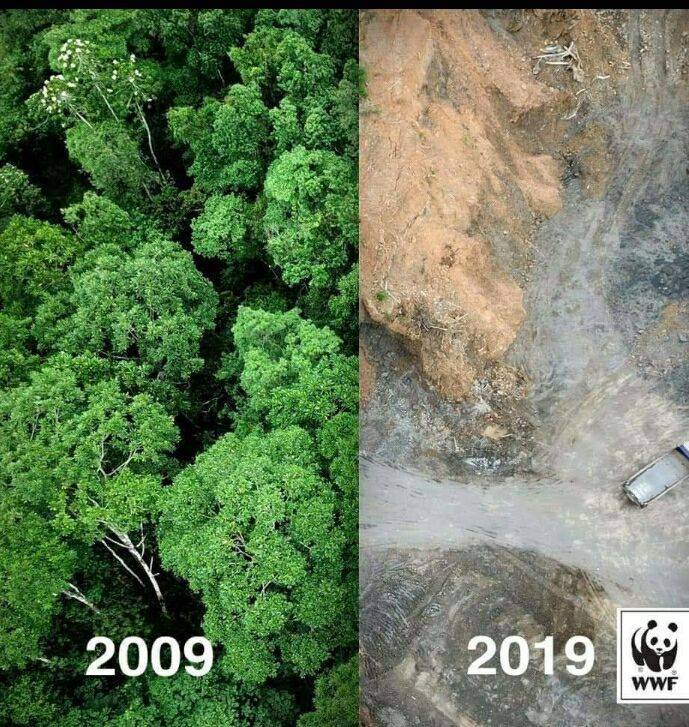
The images show the true reality that in just one decade, ecosystems can become totally degraded. To date, 7.3 million hectares of forests have been lost. If the concept of ‘business as usual’ is maintained, we will continue to see progressive degradation across all landscapes which will soon become non-existent.
The warming of the climate is a naturally occurring process, but additional anthropogenic activities has sped up the rate at which the Earth is warming. Industries are continuing to extract resources that are diminishing the natural architecture of the planet, even though there are renewable energy sources of production and resources that can be reprocessed to be used again.
The International Resource Panel report mentions natural resource extraction has more than tripled from 22 billion tonnes in 1970 to 70 billion tonnes in 2010. However, this can be reduced through the method of circular economy, whilst providing economic and social gains. This would reduce industrial waste by 80-99% and greenhouse gas emissions by 79-99%, through value retention practices.1 In turn, this will help direct towards a greener economy, to reduce the impacts upon the environment as resources have prolonged uses; increasing efficiency and subsequently reducing costs for consumers.2 Moreover, the CEO of Ditto Sustainability mentioned for businesses to ensure futurity they will need to change from today’s disposal economy to adopting the circular economy strategy. Agriprotein, a South African company that grows sustainable protein meal has adopted this approach, by 2014 they reduced CO2 emissions by 23 million tonnes per year. As a result, customer loyalty will increase especially for environmentally conscientious consumers, at the same time businesses will gain a competitive advantage to maintain or even improve their position in the market.
Goal 13 of the United Nations Sustainable Development Goals is to “Take urgent action to combat climate change and its impacts*”. To contribute towards this, the Paris Climate Agreement in 2018 was created, whereby 175 countries ratified the agreement. To reach the Paris Climate goals circular models need to be adopted, to increase efficiency whilst reducing global greenhouse gases. Re-designing supply chains for businesses is effective in progressing towards resource and overall efficiency, whereby reduce, reuse, recycle and recycle approaches for resources are used.3 In addition, product-service systems implement both products and services to consumers, therefore enhancing sustainability and positive environmental results.3 If industries implement similar practices, this would reduce waste whilst increasing efficiency within chains of production, resulting in improved quality due to reduced department numbers allowing for specialisation; enabling employees to focus on fewer job functions.
Overall, if more sustainable practices are implemented within industries, this will increase the future survival of businesses, thus reducing environmental damage benefitting all whether they are directly or indirectly participating. If we don’t start implementing strategies, the near-future will see ruins after ruins, leaving future generations to clean up the chaos created. If we don’t act now, when will we? And will we see positive environmental changes in the next 10 years?
References
1. UN Environment, International Resource Panel. (2018) Re-thinking production to boost circular economies http://www.resourcepanel.org/reports/re-defining-value-manufacturing-revolution#the_report
2. UN Environment, International Resource Panel. Re-defining Value– the Manufacturing Revolution http://www.resourcepanel.org/reports/re-defining-value-manufacturing-revolution#the_report
3. Miying Yang, Palie Smart, Mukesh Kumar, Mark Jolly & Steve Evans (2018) Product-service systems business models for circular supply chains, Production Planning & Control, 29:6, 499
 Capturing the Climate
Leave a comment